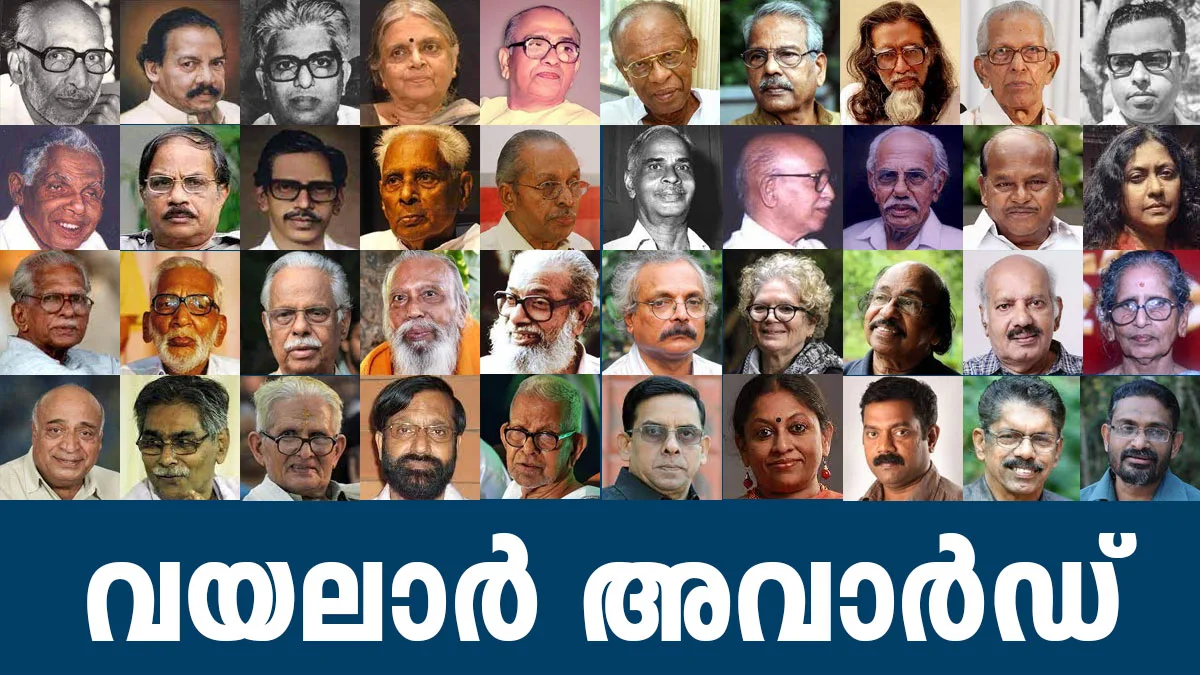
In the sacred geography of Malayalam letters, few honors carry the weight and resonance of the Vayalar Award. Instituted in 1977 by the Vayalar Ramavarma Memorial Trust, this accolade was born to immortalize the spirit of the 'Bard of Cherthala,' the legendary poet and lyricist Vayalar Ramavarma. To receive this award is to be initiated into a pantheon of greats that includes the likes of Thakazhi, MT, and O.V. Vijayan.
Presented annually on October 27—the solemn anniversary of the poet's passing—the ceremony in Thiruvananthapuram is a cornerstone of our cultural calendar. The winner is honored with a purse of ₹100,000, a silver plaque, a certificate, and a bronze sculpture by the titan of Indian art, Kanayi Kunhiraman. For the discerning bibliophile, the Vayalar list serves as the definitive syllabus for understanding the evolving soul of Kerala. Join me as we traverse the last decade of winners, each a landmark in its own right.
In this evocative novel, E. Santhosh Kumar proves once again why he is a master of the contemporary form. Set against the sprawling, labyrinthine backdrop of Kolkata—a city that has inhaled decades of refugee influx—the narrative follows the journey of the narrator into the life of Gopal Barua, a member of a refugee family from East Bengal. It is a haunting meditation on the 'secret scripts' of human existence and the eternal, exhausting search for a promised land and stable roots.
Why you should read it: It is a masterfully crafted exploration of exile and the universal human urge to find a place to call home amidst the wreckage of history.
Transitioning from the sprawling novel to the poignant depth of the short story, Ashokan Charuvil’s _Kattoorkadavu_ captures the authentic heartbeat of rural Kerala. The title refers to a riverside crossing, a literal and symbolic intersection where the lives of the common folk—tailors, harvesters, and local workers—collide. Charuvil treats his subjects with a rare dignity, focusing on the resilience and human connection that persist despite systemic poverty. It is a work that finds profound, shimmering meaning in the most ordinary of places.
Why you should read it: For its empathetic portrayal of the human condition and its ability to turn a simple village crossing into a mirror for society.
A giant of our cultural landscape, Sreekumaran Thampi—lyricist, filmmaker, and screenwriter—offers us his most intimate work yet in this autobiography. The title perfectly encapsulates the author’s life, which has swung ceaselessly between the heights of success and the depths of struggle. First serialized in _Mathrubhumi Weekly_, this memoir is a candid, often vulnerable look at his creative journey, offering invaluable insights into the history of Malayalam cinema and the personal philosophies of a man who has seen it all.
Why you should read it: It is an essential cultural document that provides a rare, unvarnished look into the mind of one of Kerala’s most versatile artistic icons.
S. Hareesh’s debut novel is arguably the most significant 'whack on the face' of banal Malayalam writing in decades. This 'bewitching phantasmagoria' centers on Vaavachan, a Pulaya and Christian convert who plays a policeman in a drama and subsequently refuses to shave his moustache. Set in the myth-drenched landscape of Upper Kuttanad, the book employs a robust magic realism where crocodiles and tortoises engage in dialogue.
In a bold stroke of descriptive brilliance, Hareesh 'crushes' the long-standing supremacy of O.V. Vijayan’s _Khasakkinte Ithihasam_, trading Vijayan’s 'pretentious' usages for a pugilistic, raw energy. Despite the controversy that saw copies of the book burned, _Meesha_ stands as a triumphant retrieval of lost words and local myths.
Why you should read it: It is an innovative, robust narrative that challenges literary conventions and explores the deep 'unknowability' of human nature.
Acclaimed for his global perspectives, Benyamin returns to his roots in this political satire. Mapping the history of the fictional village of Manthalir, the book explores how religion and politics have intertwined over twenty years. Benyamin has noted that this work contains the 'essence of his soul,' as it reflects the political scenario and Travancore ideologies he witnessed while growing up. It is a narrative that is both deeply personal and sharply critical of ideological shifts.
Why you should read it: It offers a humorous, biting, yet soulful look at the social and political evolution of rural Kerala.
In this exquisite collection of poetry, Ezhacherry Ramachandran bridges the landscape of Virginia (USA) with the soil of Kerala. The critic’s heart warms at the inter-textual links here; the collection begins by 'touching and remembering the words of M.T. Vasudevan Nair.' These poems are noted for their social consciousness, specifically those dedicated to the martyred Gauri Lankesh. Ezhacherry reclaims a lyrical traditionalism, weaving rhythm and music into verses that protest the struggles of the downtrodden while celebrating a 'human fragrance' that knows no borders.
Why you should read it: It is a lyrical feast that balances global experiences with a deep, rhythmic connection to the Malayalam language.
V. J. James presents a provocative and brilliantly executed premise in this novel. A trio of atheists—Antony, Bhaskaran, and Sahir (whose initials form the Abhasa Sangha, or 'fellowship of the debauched')—install a headless, limbless 'un-god' named Nireeshwaran to mock local superstition. The irony reaches a fever pitch when the mock-prayers offered to this 'un-god' begin to come true, forcing a profound reflection on the nature of faith vs. science. It is a gripping narrative that explores the 'God Particle' within the human inner universe.
Why you should read it: A masterclass in philosophical satire that makes the reader pause and look at the mystery of life with renewed wonder.
This historical novel is widely regarded as a 'milestone' in our literature. K. V. Mohankumar undertakes the massive task of recreating a region's history through an expansive tapestry of characters. It is an evaluation of the essence of revolution, looking at the historical struggles of the Karappuram region through a modern lens. The work is praised for its distinct narrative art, reclaiming the past to understand the revolutionary spirit that defined Kerala’s progress.
Why you should read it: An epic of revolution and remembrance that captures the very soul of a land’s struggle for justice.
T. D. Ramakrishnan, the architect behind the legendary _Francis Ittykkora_, returns with a novel that utilizes a complex dual-timeline. He blends 10th-century history—centered on the character Devanayaki—with the modern-day investigation into the murder of Dr. Rajini Thiranagama, a human rights activist supposedly killed by the Tamil Tigers (LTTE). The book is a mesmerizing blend of myths, modern politics, and historical parallels, proving that the struggles of the past are never truly over.
Why you should read it: A highly readable, intellectually stimulating work that bridges ancient history and contemporary human rights struggles.
This 'provincial narrative' is a sprawling novel that captures the essence of a lost era in Malabar. Spanning from the days of the British Raj to early independence, the story follows Ramar and a cast of over 100 characters—from tailors to coconut harvesters. The heart of the book lies in the struggle against Janmithvam (the feudal land-tenure system that caused immense social misery). It is a vivid portrayal of the freedom struggle and the dignity of the common folk who disappeared from history but live on in Kumaran's prose.
Why you should read it: An authentic masterpiece of provincial history that gives a powerful voice to the downtrodden and the anti-feudal movement.
These ten winners are more than just books; they are the pulsating heart of Malayalam literature. From the magic realism of _Meesha_ to the historical weight of _Thakshankunnu Swaroopam_, they represent a decade where our writers have dared to be irreverent, philosophical, and deeply empathetic. They honor the legacy of Vayalar Ramavarma by ensuring that the Malayalam language remains a vibrant, evolving force.
Start your collection today with one of these Vayalar-winning masterpieces, and subscribe for more deep-dives into the literary treasures of Kerala.