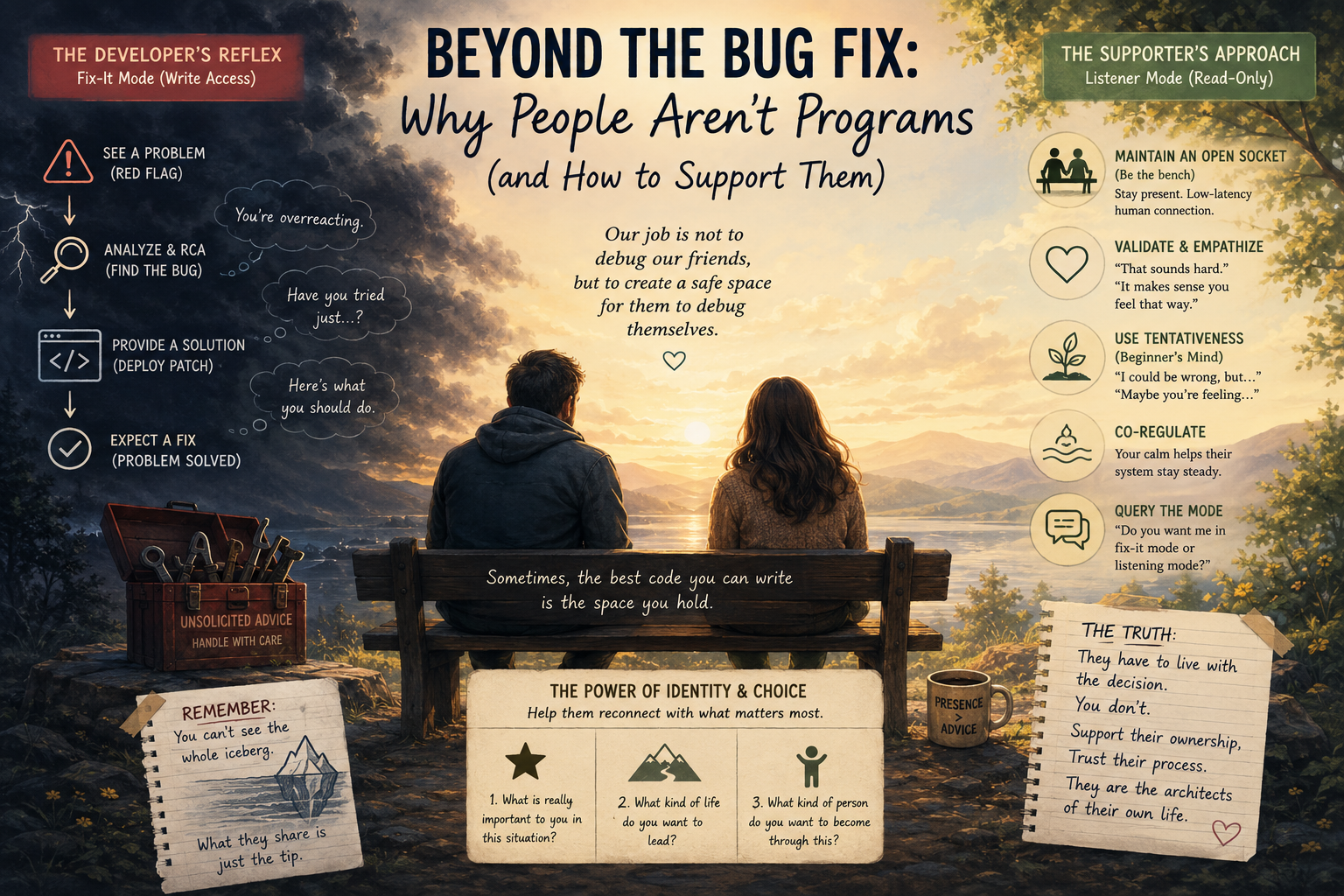
In software engineering, our troubleshooting workflow is a highly optimized pipeline. When a high-priority ticket hits the queue, we follow a rigorous protocol: ingest the requirements, analyze the technical specifications, perform a Root Cause Analysis (RCA) to find the bug, and deploy a patch. This binary approach works for logical systems because code is deterministic—it does exactly what it is programmed to do.
However, when we apply this "Developer's Reflex" to human relationships, we often trigger major system crashes. While logic is our native language, providing an immediate "fix" is frequently the wrong deployment strategy for people. Supporting a colleague or friend isn't a simple patch; it’s about navigating complex, non-linear emotional architecture. This guide explores why our instinctual advice often fails and how to provide true emotional support based on psychological first principles.
When we debug code, we have access to the full source. In human interaction, we must accept a permanent system constraint: we are working with a Black Box API. We can see the output (the tears, the anger, the stress), but we can never truly know the totality of another person’s internal logic.
What people share is merely the tip of the iceberg. Unlike software with clear documentation, people have diverse emotional needs that change in real time. Sometimes they need to vent, sometimes they need someone to simply listen, and only occasionally do they want advice.
| Feature | Software Troubleshooting | Human Support |
|---|---|---|
| Data Integrity | Clear specifications and full logs | Incomplete context (The Iceberg) |
| System Diagnostics | Logic-based Root Cause Analysis | Emotional complexity & Black Box APIs |
| End State | A fixed deployed solution | Self-determined, autonomous outcomes |
| Native State | Deterministic / Binary | Fluid / Non-linear |
When we see a problem, our instinct is to push a hotfix. However, unsolicited advice often creates unintended consequences because people interpret it differently than we expect.
Imagine sitting quietly beside someone on a bench instead of trying to move them. Sometimes your presence is far more valuable than your solution.
Acknowledge what the other person is feeling without trying to fix it. Simple phrases like "That sounds really hard" or "It makes sense you feel that way" can provide comfort.
Approach conversations with curiosity rather than certainty. Try saying, "I could be wrong, but it seems..." or "Maybe you're feeling..." instead of assuming you already know.
Your calm presence can help another person regulate their emotions. Remaining composed communicates that difficult emotions are survivable.
Before offering advice, ask: "Do you want me in fix-it mode or listening mode?" This gives the other person control over the conversation.
Your role is not to make decisions for others but to help them reconnect with their own values. Encourage them to think deeply about what matters most.
Consider a woman struggling with the difficult decision of whether to divorce. Years later, she thanked her parents because they refused to tell her what to do. They understood that no matter which path she chose, she would experience pain—but it had to be her choice.
By refusing to make the decision for her, they helped her build resilience and ownership over her own life.
True support isn't about fixing people. It's about creating a safe environment where they can understand themselves, make their own decisions, and live with the consequences. Help your friends become the senior architects of their own lives. When you stop trying to debug them, you empower them to grow.