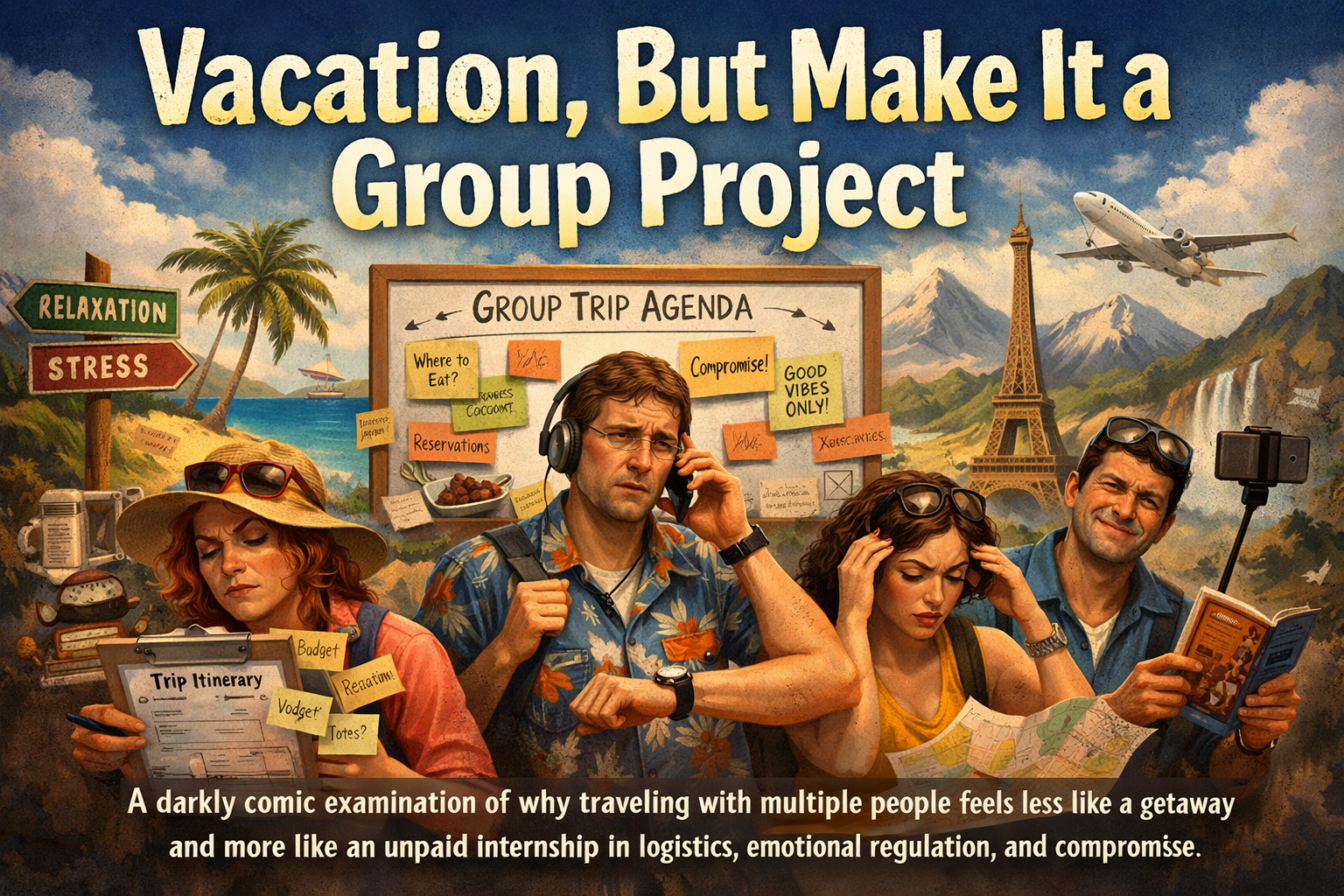
There’s a certain nostalgic romance to the idea of a group trip, isn’t there? It’s a concept painted in the warm, hazy hues of memory and imagination—a fellowship of friends or family, embarking on a grand adventure, creating shared stories for the ages.
In theory, it’s a beautiful symphony of companionship and discovery. In practice, however, it’s usually more like a high-stress negotiation held in a slightly more scenic boardroom. As a researcher of the human condition (and a connoisseur of my own sanity), I've concluded that the group trip is one of society's most elaborate bait-and-switch schemes. It promises relaxation and delivers a full-time, unpaid job in group management.
Here are four core observations from my extensive field research into this peculiar form of self-inflicted misery.
The trip’s first hurdle isn’t a language barrier or a missed train; it’s the planning phase, an ordeal so complex it makes you appreciate the simple, solitary joy of staring at a wall. In our hyper-competitive world, synchronizing schedules is a Herculean task.
Then comes the democratic process of decision-making, where every choice—from the hotel to the mode of transport—becomes a multi-pronged negotiation. Everyone wants comfort, but not everyone’s wallet is equally comfortable.
One person’s “charming, rustic getaway” is another’s nightmare. This leads to an endless vortex of searching, reading reviews, and hunting for a magical option that is cheap, luxurious, centrally located, and somehow still available last minute.
The burden of this logistical calculus almost always falls on the same one or two people, who become the group’s permanent travel agents, accountants, and therapists. By the time anything is booked, you’re already exhausted—and in desperate need of a vacation from planning the vacation.
Once on the ground, the real psychological experiment begins. A group trip operates under one unspoken, tyrannical rule: the vibes must remain good at all costs.
This noble but deeply flawed objective means that all genuine conflict is immediately swept under the nearest Persian rug. Someone is always quietly seething, smiling politely while their internal monologue performs arias of pure resentment.
Disagreements over where to eat, when to leave, or which monument to stare at aren’t resolved; they’re suppressed. The tension leaks out later as passive-aggressive comments and pointed sighs. As one astute observer put it: "If a vacation requires constant emotional labor, it’s not a vacation." It’s a performance—and an exhausting one.
The core tragedy of the group trip is the watering down of the very experience you traveled to have. Spontaneity dies quickly when every decision requires committee approval.
The desire to visit an obscure history museum? Vetoed by the hikers. An afternoon of aimless wandering? Rejected in favor of a rigid itinerary designed to please everyone—and ultimately satisfying no one.
I’ve seen plans to explore hidden city corners reduced to standing shoulder-to-shoulder at the most generic tourist landmark because it’s the only option everyone can tolerate. One particularly poignant story involved a group trip to Niagara Falls where so much time was spent deciding what to do that they ended up doing nothing at all.
The group becomes a slow-moving blob of compromise, wasting precious time debating and waiting. Individual discovery is sacrificed at the altar of consensus.
Perhaps the most fundamental problem is philosophical: people are different. We operate on different internal clocks, with different needs and desires.
Some are morning larks, eager at sunrise. Others are night owls who find noon offensively early. Some travel to conquer a checklist; others travel to simply exist somewhere new.
These differences cannot be reconciled—only compromised. Which means someone is always sacrificing their natural rhythm. The early bird feels delayed, the night owl feels rushed, the explorer feels tethered to the relaxer.
The unique cadence of each individual is forced into an awkward, unsatisfying group march. It’s an attempt to force harmony where natural—and perfectly acceptable—dissonance exists.
So what’s the takeaway? Should we all become hermits, traveling solo forever? Not necessarily. But we should be brutally honest about what a group trip really is.
It is rarely a relaxing escape. It is a challenge—a test of patience, diplomacy, and emotional endurance. Often, it’s just a change of scenery for the same old human dramas.
Perhaps true adventure isn’t in herding a group toward a manufactured good time, but in finding the rare one or two companions whose rhythms match your own—or better yet, in embracing the profound and underrated joy of getting wonderfully, spontaneously, and uncompromisingly lost all by yourself.