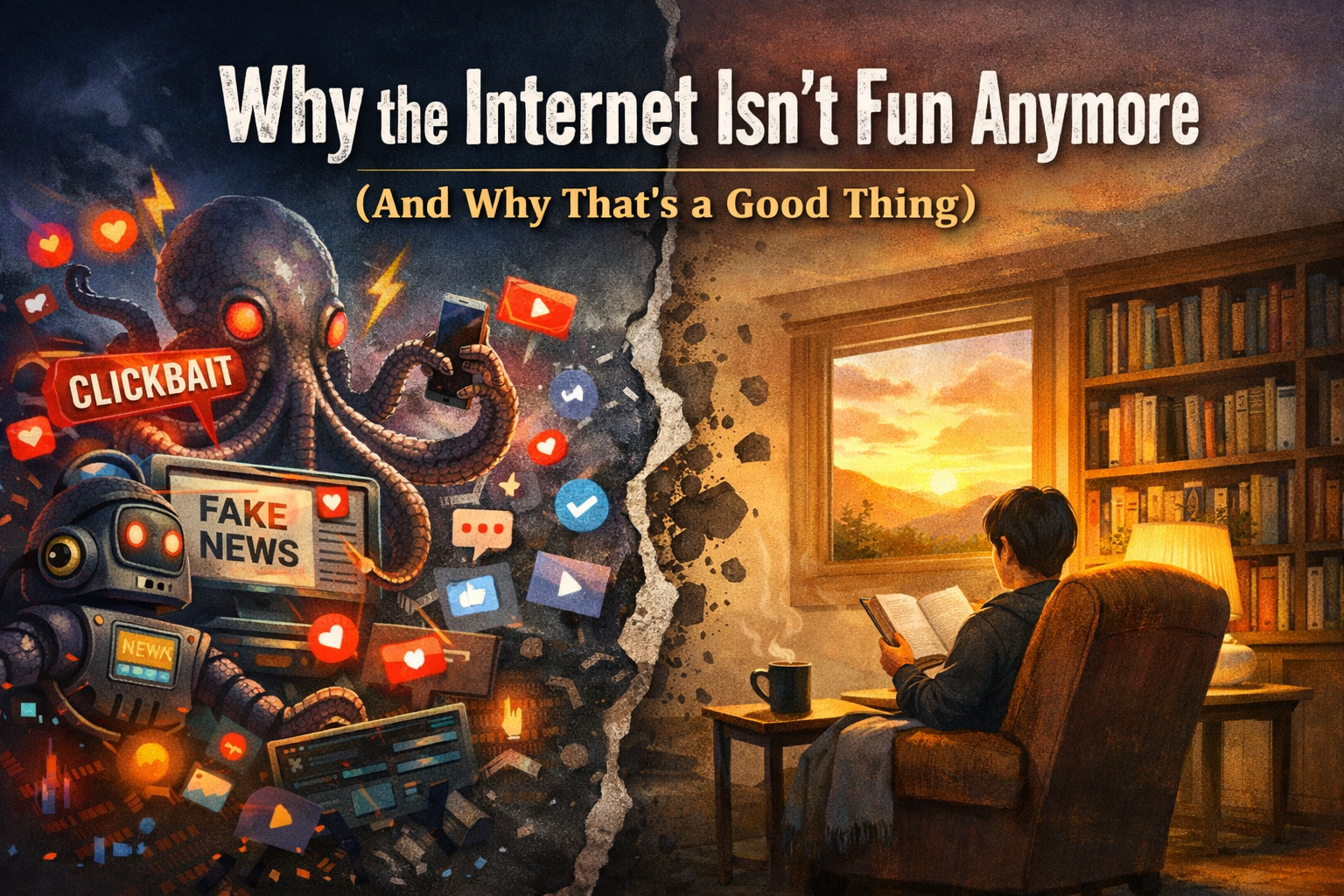
Back in high school, the internet was a slow, beautiful crawl. Bandwidth was low, and a single notification ping felt like a genuine event. We had simple Facebook walls and basic WhatsApp chats, and we actually valued the time it took for a photo to load.
Then came the explosion of cheap data plans in India, and suddenly, the entire world was shoved into everyone’s pocket. For a while, I enjoyed the ride. But now, as someone who prefers the quiet of my living room and the depth of a good movie over the digital noise, I’ve realized something: the "fun" is dead.
I used to scroll without guilt, but now, after just five minutes, my brain feels like it’s being microwaved by a bot-generated fever dream. I’m not just tired; I’m professionally exhausted.
The internet is currently being drowned in what can only be described as "AI slop." It’s a relentless tidal wave of fake posts, hallucinated news, and bots talking to other bots. We’ve reached a point where the content is so insipid and unbelievable that it triggers an immediate reflex of disbelief.
I’ll be scrolling through a feed and see an image of an AI-generated octopus eating a bus or some other bizarre, fake scenario that never happened. It’s not entertaining because there is no human behind it to connect with. If it’s not real, it’s just visual noise.
AI content has the shape of entertainment but none of the soul, making the act of scrolling feel more like a chore than a pastime.
Nothing feels original anymore because everything has been optimized into a click-trap. This is the era of the death of credibility, largely driven by the monetization of blue tick accounts. They aren’t sharing thoughts; they are farming engagement.
Platform quality hasn’t just dipped; it’s been executed. Social feeds are flooded with vague, viral posts that contain zero information—lazy bait designed purely to generate clicks and reactions.
You’ll see posts with no context and no point, just cryptic nonsense meant to trigger curiosity. It’s obvious engagement bait, yet it keeps the cycle of empty interaction spinning.
There was once a perfect machine of infinite dopamine, powered by humanity doing free quality work. We shared real lives, genuine jokes, and actual creativity in exchange for connection.
Now, platforms are trying to keep the dopamine flowing using automated, generic AI content. They believe originality can be scaled and automated, but without real human depth, the system feels hollow.
By attempting to automate the high, they’ve made the experience feel fake, boring, and fundamentally broken.
Here’s the unpopular opinion: the internet becoming unusable might be a blessing. As content becomes increasingly low-quality and artificial, it loses its addictive grip.
I’m starting to feel inoculated. Because the content is so obviously fake and annoying, I close apps faster and block accounts more freely. The boredom itself becomes the cure.
If the internet gets bad enough, it might finally push us back toward real-life conversations and tangible experiences.
The internet has shifted from a meaningful tool for connection into a draining click-bait factory. Personally, I’m opting out.
I’d rather sit in silence, read a physical book without a comment section, and enjoy the quiet. Maybe the golden age of the digital world is over—and maybe that’s a mercy.