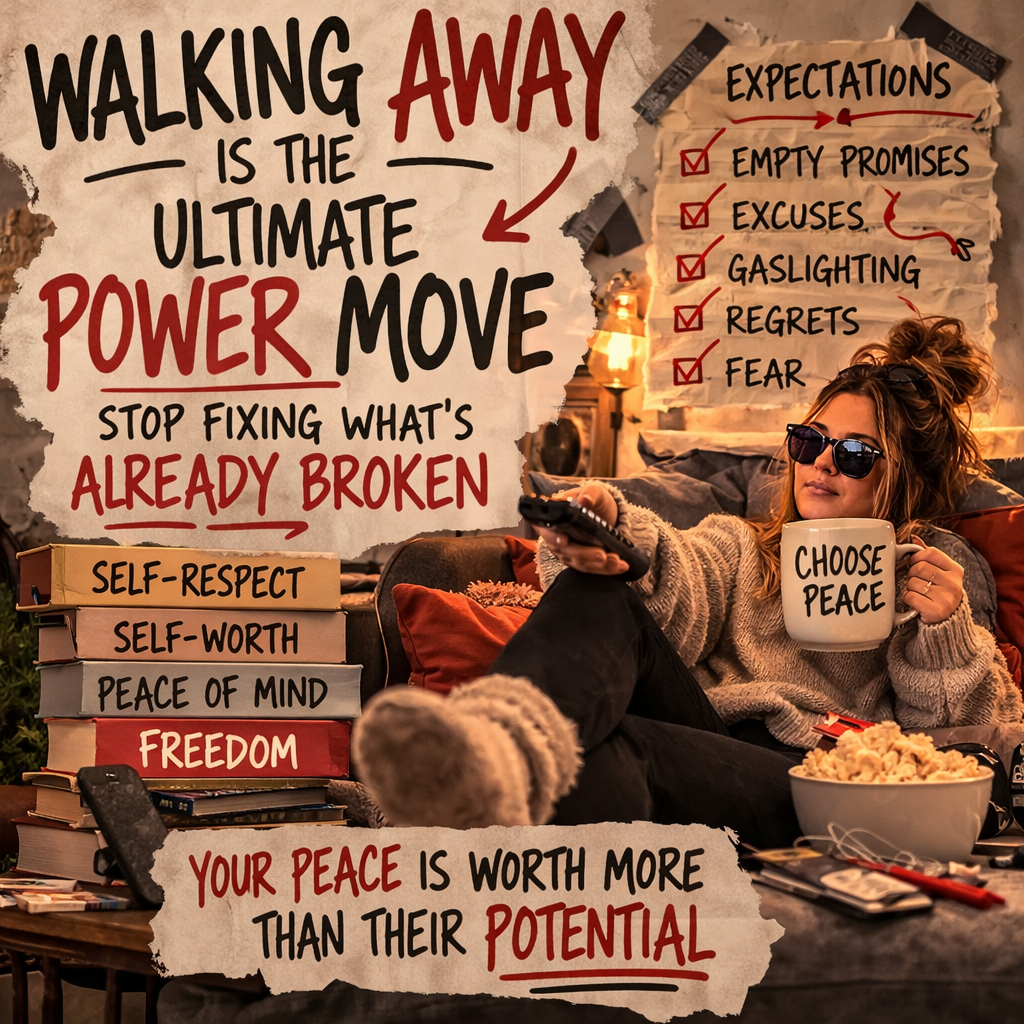
While the rest of the world is out there "grinding" through modern dating and trying to "hustle" their way into a happy ending, I am right where I belong: on my couch, knee-deep in a digital archive of 90s memes and halfway through a movie I’ve seen twenty times. From this vantage point, I’ve noticed a disturbing trend. Most people are obsessed with "repairing" things that are clearly, fundamentally broken.
We treat our relationships like a 2008 MacBook with a bloated battery and a screen held together by duct tape. We keep plugging it in, hoping for a miracle, because we’re too cheap or too scared to get a new one.I’ve realised something the "experts" rarely admit: knowing _when_ to leave is actually a more important skill than knowing _how_ to fix things. Most advice focuses on empathy and communication, but if the foundation is rotting, all the "I-statements" in the world won't keep the roof from caving in.
We have a nasty habit of staying loyal to a version of a person that doesn’t actually exist anymore. Think of it like a remastered classic movie: the version in your head has better colors and sharper sound than the original ever did.
You aren't in a relationship with the person sitting across from you; you’re in a relationship with a "future version" you’ve invented or a "past version" that has long since left the building. This is what the source material calls "mistaking hope for progress."Hope is just a feeling that acts as a distraction. Progress is a hard fact backed by evidence. If you’re staying because of who they "could" be if they just "saw the light," you’re living in a museum, not a home.
In every relationship, things break—these are called "ruptures." But most people don't actually fix them; they just let the "bloated cache" of the relationship slow everything down.You collect the hurt, the sarcasm, and the ignored needs like old receipts, stuffing them into a mental drawer. Eventually, the drawer is so full of "corrupted save files" that you can't even close it anymore.Most of what we call "fixing things" is just "performance repair." You say "I’m sorry" because you want the tension to end, not because you plan on changing.
I see the younger generation especially struggling with "self-gaslighting." This is a survival strategy where you talk yourself out of your own reality because the truth is too scary.
Your brain is literally glitching. It’s trying to manage Cognitive Dissonance—the mental pain of holding two conflicting facts at once (e.g., "I love them" vs. "They treat me like garbage"). To stop the pain, your brain tells you that slightly moldy bread is better than no bread at all. But ask yourself: do you really want to eat moldy bread?To stop this, you need to use "Plain Language." We use fancy words to hide from the truth. We say "I’m overwhelmed" when the plain truth is "I’m scared of my partner."
Your biology is actively trying to keep you stuck. It’s called Loss Aversion—your brain hates losing what it has more than it values gaining something better.
Even worse, bad relationships often run on Intermittent Reinforcement. It’s like a slot machine: the "good moments" are rare, but when they happen, you get a massive burst of Dopamine.You stay stuck in the "familiar pain" of the casino because your brain is addicted to the occasional payout.
People love making "pros and cons" lists. They’ll have forty pros ("they're funny," "they have a good job") and only three cons ("they mock me," "I feel lonely," "I don't feel safe"). They think the forty pros win the vote.But relationship math isn't a democracy; it’s a foundation. One major con cancels out forty pros. If you don't have the basics, the house isn't standing.
And for those with kids: staying in a destructive spot isn't "protecting" them. It’s instructing them. You are teaching them that love means enduring unhappiness and self-silencing.
That is a legacy of "moldy bread" that no child should inherit.
Leaving isn't a failure; it’s a "Gateway to Liberation." It is the ultimate power move because it proves that you value your own internal space more than a partnership that requires you to abandon yourself.We’ve been taught that "quitting" is for the weak, but in a world obsessed with fixing the unfixable, walking away is an act of extreme self-preservation.You stop the process of shrinking. You stop the "scorekeeping" at the used car lot of bad apologies.
You finally decide that the "unfamiliar uncertainty" of being alone is better than the "familiar pain" of being invisible.Now, if you’ll excuse me, my movie is at the best part and I have a trending meme to deconstruct.Life is too short to spend it repairing a relationship that makes you feel like a guest in your own life.
You deserve to take up space. Go do that.